Many couples who are getting married often ponder over one question. What’s the difference between the engagement ring vs wedding ring?
The two rings mark different points in the story. One comes with the proposal. The other is exchanged on the wedding day. Once you look at them that way, the distinction becomes fairly straightforward.
Table of Contents- What Is an Engagement Ring?
- What Is a Wedding Ring?
- Difference Between Engagement Ring and Wedding Ring
- How to Choose the Right Engagement Ring and Wedding Ring
- Popular Engagement Ring Styles
- Popular Wedding Ring Styles
- Discover Engagement Rings and Wedding Rings at Aukera Jewellery
- The engagement ring comes first. It marks the proposal and the decision to get married.
- The wedding ring comes later, during the ceremony. That's the ring that marks the marriage itself.
- You can wear both. You can wear one. There is no hard rule here.
- If you're buying both, try them on together. A straight band and a raised solitaire can leave a gap. Sometimes that's fine. Sometimes it drives you mad.
- Metal is worth thinking about too. Platinum is low-maintenance and hard-wearing. White gold needs its rhodium finish renewed. Yellow and rose gold are more about the colour you like.
- Don't let an old spending rule choose your rings for you. Work out what you're comfortable spending and go from there.
- Most importantly, the ring has to work on your finger, not just in the box.

What Is an Engagement Ring?
An engagement ring is the ring given at the proposal. It marks the period between saying yes and getting married, worn on the finger through the engagement as something visible and permanent.
Most feature a centre diamond. Partly tradition, partly because an engagement ring is worn for years before the wedding and often decades after it. A prominent diamond holds up to that.
Engagement Ring History & Origin
In 1477, the Archduke Maximilian of Austria presented Mary of Burgundy with a ring. It was the first recorded engagement ring. But people had been exchanging rings to mark betrothals long before diamonds became the default. The diamond came later.
Engagement Ring Meaning & Symbolism
What is an engagement ring?
At its simplest, it is the ring that says: we're getting married.
The meaning used to be tied to families, arrangements and money as much as it was to the couple. These days, that part has mostly fallen away. The ring is really about the woman wearing it and the stone, shape and design she prefers.
What Is a Wedding Ring?
The wedding ring comes later.
It is the ring exchanged during the ceremony itself, and traditionally sits closest to the palm when worn with an engagement ring.
Most are bands. Some are completely plain. Others have diamonds set into the metal. The circular shape has been associated with continuity for centuries, which is probably why it has lasted so well.
Wedding Ring History & Origin
Wedding rings are much older than engagement rings.
The ancient Egyptians used rings made from materials such as reeds and leather. Romans later used iron rings during marriage ceremonies. Gold became more common much later, particularly across medieval Europe.
Then there is the fourth finger of the left hand.
The Romans believed there was a vein there that ran directly to the heart. They called it the vena amoris.
There isn't.
People kept wearing the ring there anyway.
Wedding Ring Meaning & Symbolism
The wedding ring has quite a major ceremonial significance.
The engagement ring belongs to the period when marriage is still ahead of you. The wedding ring arrives when the vows are actually being made.
For some couples, that makes it the more meaningful ring. Not because it is bigger or more expensive. Because of the day attached to it.

Difference Between Engagement Ring and Wedding Ring
The difference between an engagement ring and a wedding ring comes down to the occasion.
The engagement ring is for the proposal.
The wedding ring is for the wedding.
Everything else, the size of the diamond, the style, whether you wear one or both, is much less fixed.
| Engagement Ring | Wedding Ring | |
|---|---|---|
| Purpose | Marks the proposal | Exchanged at the ceremony |
| Design | Usually features a centre diamond | Usually a band |
| Symbolism | Commitment to marry | The marriage itself |
| Typical Wear | Alone during engagement | Below the engagement ring after |
How to Choose the Right Engagement Ring and Wedding Ring
Choose a Matching Set
It helps to think about both rings as a pair before either one is bought.
Not because they have to match exactly. They don't.
The proportions, metal and smaller design details simply need to make sense together. A curved wedding band can sit neatly around a solitaire. A straight band may leave a gap beside a raised engagement ring. Some people like that separation. Others don't.
Engagement rings and wedding bands at Aukera share a design language across the bridal collection, so the two can be chosen together rather than pieced together afterwards.
Select the Right Metal
The metal usually starts with what you already like wearing.
Already wear a lot of gold? Yellow gold will probably feel right. White gold is cooler and cleaner, but the rhodium finish needs doing again every so often. Rose gold sits somewhere warmer and softer between the two.
Platinum is a different proposition. It stays naturally white, is very hard-wearing and doesn't need replating.
There is no universally better metal.
The easiest place to start is the colour you like. After that, think about how you actually wear your jewellery and whether a little upkeep bothers you.
Consider Your Lifestyle
Put the ring on and live with it for a few minutes.
Move your hand around. Make a fist. See if the setting catches on anything. Notice the band. Is it noticeable enough?
That becomes more important when the ring is going to stay on every day. Someone who uses their hands a lot may prefer a lower setting and a stronger band. Someone who rarely removes their rings may care just as much about how it feels after hours as how it looks in the first minute.
Set Your Budget
Forget the two-month salary rule.
It wasn't a financial rule. It was a marketing idea.
Work out what you're comfortable spending across both rings and start there. Lab grown diamond pricing gives you more room to move within that amount. Maybe a larger centre stone, or a better cut, maybe a more elaborate setting.
You don't have to spend more simply because you can.

Popular Engagement Ring Styles
Solitaire Rings
One diamond, nothing else competing for attention.
It's still the most popular engagement-ring format, partly because it gives the diamond room to do all the work. The setting stays relatively quiet.
The shape changes the personality of the ring. Round brilliants remain the classic choice. Ovals tend to look larger for their weight. Emerald cuts have a cleaner, more architectural feel. Cushion cuts are softer.
Solitaire rings at Aukera include Enhanced Hearts & Arrows™, Extra Brilliant™ and the Ashtalakshmi Solitaire™, each developed around a different approach to cut and light performance.
Halo Rings
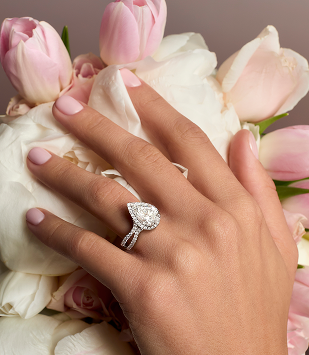
A halo surrounds the centre diamond with smaller stones, adding more detail and visual presence without having to increase the size of the centre stone.
Hidden halos are a variation worth knowing about. The smaller diamonds sit beneath the centre stone rather than around it, so from the top the ring looks quite clean. The extra diamonds only become obvious from the side.
Vintage Rings
Some of the details that make a ring feel vintage are wonderfully small.
Milgrain. Tiny pavé diamonds. Art Deco geometry. Edwardian-inspired lines.
You don't have to want something that looks like it came out of another century. A vintage-inspired ring can simply have more detail to discover when you look closely.
Three-Stone Rings
Three stones can produce a surprising number of different looks.
A round centre with tapered baguettes feels quite sharp. Swap those for cushion-cut sides and the same basic arrangement becomes softer. Change the centre to an oval and the whole ring shifts again.
The three stones are often associated with past, present and future.
Some people love that. Others just like the composition.
Popular Wedding Ring Styles
Classic Wedding Bands
A plain gold or platinum band remains one of the easiest choices to live with.
It works with almost any engagement-ring profile and doesn't require much thought once it's on the hand.
Diamond Wedding Bands
There are several ways to set diamonds into a wedding band.
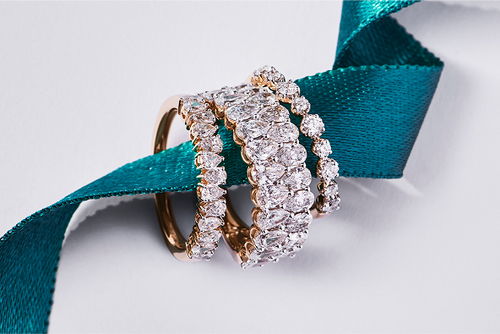
Channel-set diamonds sit within the metal. Pavé uses tiny beads to hold the stones close together. Prong-set diamonds sit slightly higher and allow more light around each stone.
The setting changes both the look of the band and how it sits against the engagement ring.
Eternity Bands
Diamonds continue all the way around the ring.
The effect is beautiful, but there is a practical point to consider. Full eternity bands are difficult to resize because stones cover the entire circumference.
That is worth thinking about before buying, particularly if your finger size might change.
Curved Wedding Bands
A curved band follows the shape of the engagement ring.
It can sit closely around a centre stone and remove the gap that sometimes appears when a straight band is paired with a raised solitaire.
Try the two rings on together before deciding. Certain settings make a curved band a much better fit than a straight one.

Discover Engagement Rings and Wedding Rings at Aukera Jewellery
Every lab grown diamond at Aukera is independently certified by IGI, with GCAL 8X or GemEx certification added for collections where light performance is central to the design.
Diamond rings across the collection range from classic solitaires and contemporary halo designs through to Aukera's signature innovations. Engagement rings and solitaire rings are available across a full range of shapes, carat weights and settings, with complete IGI certification for every diamond.
Wedding bands and band rings follow a shared design language across the bridal collection. Men's rings are available in classic bands as well as contemporary diamond-set designs.
The Diamond Bar at every Aukera store is a useful place to try the two rings together. You can put different bands beside the engagement ring, see where they leave a gap, check the proportions and decide which combination actually looks right on the hand.