A one-carat solitaire sounds like a pretty straightforward choice.
Until you start looking at actual diamonds.
Because the carat defines the weight of the diamond, but can’t tell you anything about how it will look. The shape matters and the proportions do too.
A 1-carat round is very different from a 1-carat oval. When you look at two 1-carat rounds, the measurements can look very different.
So when you're comparing solitaire diamond size, look at the carat and the millimetres. You need both to get a proper sense of the stone. Keeping a solitaire diamond size chart when comparing your options serves as a useful starting point.
Table of Contents- Understanding Solitaire Diamond Size
- Solitaire Diamond Size Chart: Carat, Dimensions & Appearance
- How to Read a Solitaire Diamond Size Chart
- Solitaire Diamond Size Comparison: How Different Carat Sizes Look
- How to Choose the Right Solitaire Diamond Size
- Natural vs Lab Grown Solitaire Diamonds
- Carat is weight, not measurement.
- Millimetres is the correct measurement for how the diamond is visually.
- Shape changes everything. An oval doesn't spread across the finger like a round of the same weight.
- Cut matters too, especially when it comes to the proportions.
- Try diamonds on before deciding.

Understanding Solitaire Diamond Size
What Does Carat Weight Mean for Diamond Size?
The carat is the weight of the diamond. One carat is 0.2 grams.
But it cannot tell you anything about the visual size of the diamond. Some diamonds carry more weight underneath. Others spread that weight over a wider face and look bigger from the top.
You'll notice this when you start comparing solitaire rings. A 1-carat stone, a 1.5-carat stone and a 2-carat stone don't necessarily look twice as big as you move up the scale.
The numbers go up neatly. The diamonds don't.
Carat Weight vs. Diamond Dimensions
This is where millimetres become useful.
Look at the measurements on the diamond certificate. For a round diamond, the dimensions tell you its diameter. In the case of ovals, pears or marquise, the length and width become important.
Look at two 1 carat diamonds.
One may have a face-up width of about 6.4 mm. Another may be cut a little differently and measure something else.
Same weight.
Different amounts of diamond looking back at you.
That is why a useful solitaire diamond size chart needs more than a column of carat weights.
Solitaire Diamond Size Chart: Carat, Dimensions & Appearance
The figures below are approximate references for round brilliant diamonds. Individual stones will vary according to cut and proportions.
| Carat Weight | Approx. Dimensions | General Appearance |
|---|---|---|
| 0.25 ct | ~4.1 mm | Small and delicate |
| 0.50 ct | ~5.1 mm | Noticeable, but restrained |
| 0.75 ct | ~5.8 mm | More presence without feeling large |
| 1.00 ct | ~6.4 mm | A familiar, balanced solitaire size |
| 1.25 ct | ~6.9 mm | More obvious across the finger |
| 1.50 ct | ~7.4 mm | Clearly substantial |
| 2.00 ct | ~8.1 mm | Strong centre-stone presence |
| 2.50 ct | ~8.8 mm | Large and hard to miss |
| 3.00 ct | ~9.3 mm | Very prominent |
Remember, this table is simply a reference. Diamond cutting isn’t exact and measurements can be slightly different for each diamond.

How to Read a Solitaire Diamond Size Chart
Understanding Carat Weight and Millimetre Measurements
The carat number is the obvious place to begin.
Then check the measurements.
A 1-carat diamond and a 1.25-carat diamond look quite similar. The extra 0.25 weight may not mean a wider dimension.
So yes, the 1.25-carat stone will generally look bigger.
Just not in a neat 1.25-to-1 ratio.
Why Two Diamonds of the Same Carat Can Look Different
Shape is one reason.
A long oval spreads the weight along the finger. A round diamond keeps things more compact. Pear and marquise cuts have their own proportions again.
Cut is another.
A diamond that is too deep may have a lot going on underneath while giving you less face-up spread. Another diamond can use its weight differently and look broader from above.
Then there is the setting.
A high solitaire exposes the stone differently from a low, close-to-the-finger setting. The band width changes the proportion of the whole ring too.
So when you're making a solitaire diamond size comparison, don't look at carat alone.
Solitaire Diamond Size Comparison: How Different Carat Sizes Look
0.50 to 0.75 Carat Solitaire Diamonds
This is the quieter end of the scale.
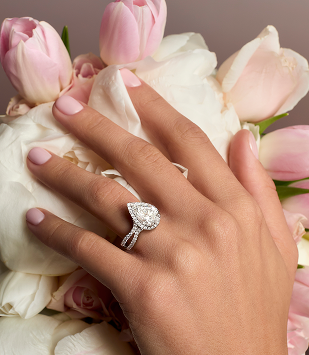
A half-carat solitaire doesn't disappear. It simply doesn't take over the hand. Ideal for someone who prefers delicate jewellery.
Let’s talk about three-quarters of a carat. The character of the ring changes subtly as the diamond becomes a little more visible.
These sizes can also leave more of the budget available for the things people sometimes overlook: a particular setting, a better cut or the metal they actually wanted.
1 to 1.5 Carat Solitaire Diamonds
Now we start to see a real change.
1 carat round is 6.4 mm across. 1.5 carat is 7.4 mm.
That extra millimetre is quite visible on the finger.
The centre stone has more presence. The ring begins to feel more like a proper statement piece while still remaining very easy to wear.
This is also the range where cut becomes increasingly important. A larger diamond gives the eye more surface to examine.
2 Carat and Larger Solitaire Diamonds
At 2 carats, you start noticing the diamond before anything else.
There is simply more of it on the finger. The setting shows more too, so the height, band and prongs become harder to ignore.
A 3-carat round measures 9.3 mm in width. But a larger diamond with weak proportions can seem quite flat. A well-cut 2-carat stone can have much more presence.
Two carats tells you the weight.
The hand tells you the rest.

How to Choose the Right Solitaire Diamond Size?
Consider Your Finger Size
The same diamond looks different on different hands.
The same diamond won't read the same way on every hand. On a narrower finger, 1 carat can look quite prominent. On a wider finger, it may feel more understated.
So the chart doesn’t tell the whole story. There’s no fixed answer.
Try different sizes.
Look straight down at your hand.
Then turn it sideways.
Sometimes the stone you thought was too small looks exactly right. Sometimes the larger one is simply more of everything.
Consider the Ring Setting
The setting can change the entire impression.
Four prongs leave a good amount of the diamond exposed. Six prongs bring a little more metal into the picture. A bezel sits around the edge and gives the ring a lower, cleaner profile.
The height of the centre stone matters too.
A high-set solitaire has more drama from the side. A low setting can feel more secure and understated.
This is why choosing the diamond and choosing the ring aren't really two separate decisions.
Balance Diamond Size With Your Budget
It is very easy to get fixated on the carat number.
Try not to.
If the budget allows you to choose either a larger diamond with weaker cut or a slightly smaller stone with better proportions, the second one may look much better once it is actually on the hand.
Lab grown diamonds can give you more freedom here. Because they are generally more accessible than natural diamonds at comparable specifications, buyers may have room to move up in carat while still paying attention to cut, colour and clarity.
Aukera's solitaire diamond rings are built around that same idea: the diamond has to look right, not simply read well on paper.
Natural vs Lab Grown Solitaire Diamonds
Natural and lab grown diamonds can both be used in a solitaire.
"Solitaire" tells you about the design. It doesn't tell you where the diamond came from.
Lab grown diamonds are created above ground using CVD or HPHT methods. Natural diamonds form underground over geological time. Once cut and polished, the two have the same basic physical and optical properties.
So you're still looking at the same questions:
- How is it cut?
- What's the colour?
- What's the clarity?
- How much does it weigh?
- And what does it actually look like?
At Aukera, lab grown diamonds used in solitaire settings carry independent IGI certification. Selected collections where light performance is central also have GemEx or GCAL 8X certification.
The solitaire format goes well beyond engagement rings too. There are solitaire diamond earrings, solitaire diamond pendants and solitaire diamond mangalsutra designs, each using the same basic idea: one diamond gets to be the focus. Explore Aukera’s collection of certified lab grown diamond solitaires.